
How China’s Rising Yuan Could Impact the USD
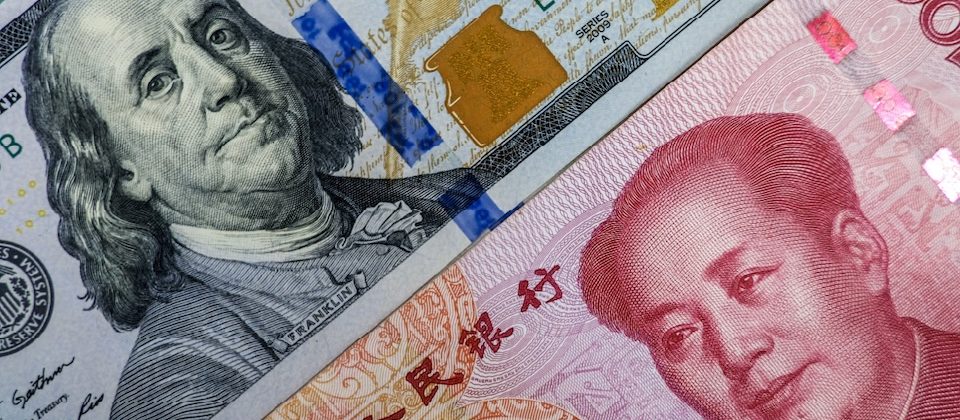
As of November 2025, China pays for over 30% of its $6.2 trillion trade in goods and services in the yuan, rather than US dollars. This is a meaningful rise from the yuan accounting for 20% of China’s trade in 2022. The Asian currency is gaining importance, having overtaken the euro briefly in 2024 as the second-most used currency in global trade. Plus, as of October 2025, the Chinese yuan (CNY) now accounts for over 2% of the global currency reserves.
So, what does this mean for forex traders, especially those trading the CNY/USD?
How Does a Rising Yuan Impact the Mighty Dollar?
China and the US have been long-standing rivals. Their rivalry creates several opportunities in the financial markets.
Trade-balance Shift
As the yuan strengthens, Chinese exports become more expensive in foreign currency terms, potentially narrowing China’s trade surplus and reducing demand for the USD from Chinese exporters.
Risk of USD Weakening
If China continues to reduce its holdings of USD assets and shifts towards greater yuan usage in cross-border trade, the global demand for the dollar could weaken. As of November 2025, the Red Dragon conducted 99% of its trade with Russia in Chinese yuan, which has replaced the USD as the most traded currency in Russia.
Redefining Capital Flows
A stronger yuan may attract capital into China and broadly to other Asian nations. This can threaten the safe-haven status of the USD, further exerting downward pressure on it.
Economic Growth
A strengthening yuan is seen as a positive sign for the export-driven Chinese economy. It builds investor confidence in the limited need for export-related stimulus, which could bolster non-USD currencies. Analysts at JPMorgan Chase now expect the CNY/USD to trade at about 7.15 into 2026.
De-dollarisation
China’s push to invoice trade in yuan can reduce reliance on the dollar ecosystem. Major trade partners of the country are okay with this de-dollarisation, which represents a structural challenge to USD dominance.
A Word of Caution
Although the Chinese yuan appreciated against the USD in 2025, it remains one of the weaker performers in Asia. This means broader de-dollarisation, which could lead to a decline in dollar demand, does not necessarily translate into appreciation for the yuan. While this could be considered an intentional policy to spur the export-centric economy, it could also give rise to trade tensions. This is because several of its Asian peers, including India and Taiwan, are in competition to grab a larger share as global supply chains reshape amid tariff threats.
The Current State of the USD-CNY Rivalry
By September 10, 2025, the greenback had declined 7% YTD on a trade-weighted basis. This was after it had the worst start to the year in over 5 decades. Donald Trump’s trade policies, USA’s rising debt and threats to the Fed’s independence, all pressured the US dollar. Meanwhile, the CNY rose 2.5% YTD and the DXY declined 8% YTD by November.
Whether the CNY replaces the USD or not, the current atmosphere is one with abundant trading opportunities.
What to Watch While Trading the CNY/USD
To take advantage of the opportunities arising out of the USD-CNY rivalry, traders need to watch the following:
PBOC Guidance
The People’s Bank of China sets a daily reference rate for the yuan. This prevents the currency’s rate from fluctuating too much. Observing the values and how they change over time can offer insights into the bank’s policy and any changes in it.
Global USD Holdings
Countries worldwide are replacing their USD reserves with gold. A sustained decline in USD holdings, with increased selling, could signal a long-term decline in dollar demand. This is set to hurt investor sentiment, exerting downward pressure on the greenback.
Trade Settlement Breakdowns
The more global trades are settled without the USD, the lower the demand for the currency. Against this backdrop, a surge in trade settlements in CNY means further strengthening of the yuan.
Global Risk Sentiment
A risk-on sentiment means traders are less likely to invest in safe havens, such as gold and USD. This may result in lower USD-based carry trades. At the same time, if the yuan strengthens, it could further exert downward pressure on the greenback.
Fed’s Polices
As of November 2025, the Fed plans to lower the repo rate at least once more in 2025, with two cuts in 2026. Declining interest rates push traders away from a currency, exerting downward pressure on it.
How to Trade the CNY/USD
Derivative instruments, such as CFDs, are a popular choice for trading volatile asset classes. This is because they allow traders to explore the opportunities in both rising and falling markets. Plus, traders can hedge against risks with a position in the opposite direction.
While fundamentals and news events may offer insights into market sentiment, technical analysis helps spot entry and exit points. Some technical indicators used popular to trade the CNY/USD are:
Bollinger Bands
Bollinger Bands form a channel around the price, indicating the support and resistance levels. The upper and lower channel levels serve as entry and exit points in different conditions. For instance, if the price hits the lower band with market conditions indicating a reversal, it is seen as a signal to open a long position.
Relative Strength Index
RSI helps determine whether an asset is overbought or oversold. A value of over 70 indicates oversold conditions. At this point, if the price reaches a support, it is considered ripe for reversal.
To Sum Up
- China’s yuan is challenging the USD’s global dominance.
- The USD is declining due to debt and government policy, while the CNY has appreciated.
- A strong CNY attracts capital to Asia, threatening the USD’s safe-haven status.
- Traders must watch PBOC rates, global USD holdings and Fed policies while trading the CNY/USD.
- CFDs are a popular way to trade the CNY/USD.
Disclaimer:
All data, information and materials are published and provided “as is” solely for informational purposes only, and is not intended nor should be considered, in any way, as investment advice, recommendations, and/or suggestions for performing any actions with financial instruments. The information and opinions presented do not take into account any particular individual’s investment objectives, financial situation or needs, and hence does not constitute as an advice or a recommendation with respect to any investment product. All investors should seek advice from certified financial advisors based on their unique situation before making any investment decisions in accordance to their personal risk appetite. Blackwell Global endeavours to ensure that the information provided is complete and correct, but make no representation as to the actuality, accuracy or completeness of the information. Information, data and opinions may change without notice and Blackwell Global is not obliged to update on the changes. The opinions and views expressed are solely those of the authors and analysts and do not necessarily represent that of Blackwell Global or its management, shareholders, and affiliates. Any projections or views of the market provided may not prove to be accurate. Past performance is not necessarily an indicative of future performance. Blackwell Global assumes no liability for any loss arising directly or indirectly from use of or reliance on such information here in contained. Reproduction of this information, in whole or in part, is not permitted.