
Factors Impacting the Vietnamese Dong in 2026
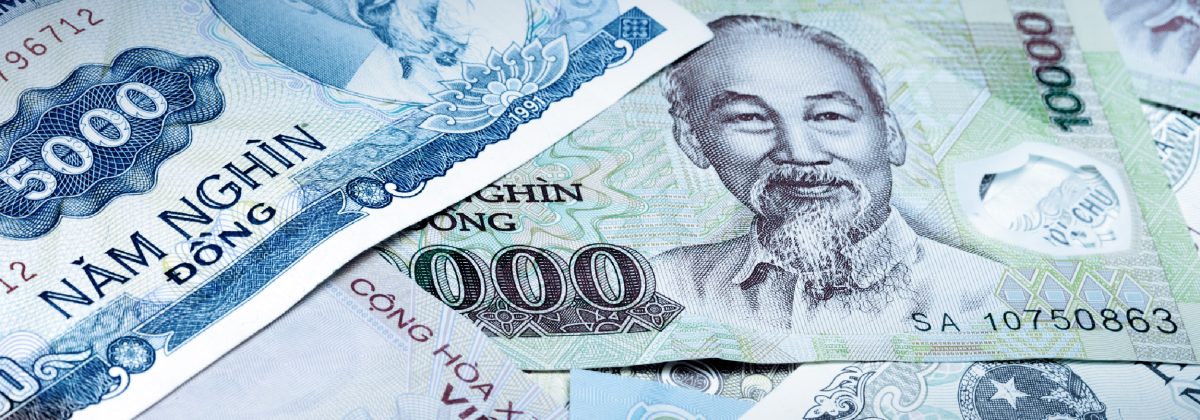
The Vietnamese dong (VND) entered 2026 as one of the weakest currencies in the world. Yet, preliminary analysis shows that Vietnam’s economy grew by 8.02% in 2025, making it the fastest-growing economy in Asia, despite trade tariffs. The currency’s landscape is changing, given the global trade shifts and domestic reforms.
USD/VND Outlook for 2026
Cautious optimism is the widespread sentiment for the dong in 2026. According to MUFG analysts, Vietnam’s economy has a “modest risk of overheating,” given the positive structural reforms implemented through 2025. A KPMG report emphasises that while infrastructure projects seem effective, the dong’s fate depends on whether they stay on schedule. Foreign direct investment (FDI) demand may support the currency through 2026.
The Vietnamese dong is expected to remain volatile through 2026. Keeping an eye on the factors moving the currency can help you refine your forex trading strategies for USD/VND.
Tailwinds Lifting the Vietnamese Dong
Several tailwinds are pushing the dong and may help curtail rapid depreciation.
Strong FDI
Vietnam is becoming a preferred supply chain relocation destination for businesses expanding out of China. This potentially creates a constant demand for the dong as firms pay for local labour and materials.
Manufacturing and Export Growth
The manufacturing sector remains one of the key growth drivers for the Vietnamese economy. In early 2026, export orders for electronics and textiles reached new highs. Exports grew strongly in late 2025, with a 21.3% year-on-year (yoy) increase in the fourth quarter, and total traded value of $930 billion for the year. The country ran a trade surplus of about $20 billion in 2025, which provides the State Bank of Vietnam (SBV) with the US dollars needed to stabilise the local currency.
Structural Reforms
The Vietnamese government is pushing to be an emerging market, instead of a frontier one. This has led to improvements in governance and stock market transparency, which attracts investors. Robust capital inflow acts as a strong support level for the VND.
Tourism Recovery
International tourism reached its highest level in 2025, with 21.2 million arrivals, 20.4% higher than in 2024. Travellers exchanging foreign currency for the dong also add to liquidity and create consistent demand for the currency.
Interest Rates
The SBV is expected to keep the refinancing rate between 4.5% and 5% in 2026, while the Fed may lower interest rates. This means the interest rate differential between the VND and USD may remain small. With similar interest rates, investors tend to prefer the cheaper and faster-growing currency.
Headwinds for the USD/VND
Despite the growth, there are headwinds that could put pressure on the USD/VND.
Global Trade Policy
Vietnam is sensitive to US trade policy. Any talk of currency manipulation or new tariffs on Vietnamese goods causes instant volatility in the USD/VND rate.
Inflationary Pressures
Rapid growth brings a risk of the economy overheating. If the price of energy and food rises too fast, the SBV may be forced to intervene. This is because high inflation tends to erode the purchasing power of the VND.
Infrastructure Bottlenecks
KPMG highlighted that power shortages and port congestion are prominent issues in Vietnam. These impact manufacturing output and export management. If the government fails to improve the infrastructure, investors may look elsewhere to replace China. This may potentially draw capital out of the country.
Performance of the Greenback
If the US Federal Reserve keeps interest rates higher for longer, the US dollar will stay strong. This makes it difficult for the dong to gain ground, even with a strong local economy, since the USD is far more stable and a safe-haven asset.
What to Watch When Trading the USD/VND
Trading the Vietnamese dong is different from trading major pairs like the EUR/USD. The SBV sets a central parity rate every morning. Commercial banks can only trade within a fixed band around this level (currently +/- 5%). For intra-day traders, these levels work as the potential floor and ceiling for the day.
SBV Daily Central Parity Rates
When SBV moves the rate up multiple days in a row, traders consider it a planned depreciation. This is when they tend to take short positions. With derivative instruments, such as contracts for difference (CFDs), traders can explore opportunities in both price directions.
FDI Disbursement Figures
Monthly data on how much money is actually being spent by foreign companies reveals the demand for support for the VND. Higher demand supports the currency.
Manufacturing PMI
The Purchasing Managers’ Index (PMI) shows if the manufacturing sector is expanding. A PMI score above 50 is bullish for the economy and the currency.
Trade Balance Data
Vietnam needs a trade surplus to maintain its foreign exchange reserves. Traders watch the monthly export and import balance closely. Historically, a narrowing surplus weakens the dong.
Forex Trading Strategies for 2026
Since the VND is a managed currency, range-play and policy-based strategies are more intuitive to use.
Trading the Band
Identify the top of the SBV’s permitted trading band. When the market price hits the upper limit, it often bounces back down unless the SBV officially devalues the currency.
Event-Driven Analysis
Major announcements regarding stock market upgrades or trade deals with the US often cause a surge in demand. Traders use these news events to enter positions before the trend stabilises.
To Sum Up
- Vietnam’s economy grew 8.02% in 2025, driven by high exports and a trade surplus.
- The VND started 2026 as one of the weakest global currencies with persisting volatility.
- Strong FDI from China, diversification, manufacturing demand and tourism indicate potentially sustained demand for the VND through 2026.
- US trade policies, inflation risks, infrastructure bottlenecks and FDI may continue to move the Vietnamese dong through 2026.
- Watching daily parity set by the SBV, FDI disbursements, PMI and trade balance can help you refine your forex trading strategies for USD/VND.
Disclaimer:
All data, information and materials are published and provided “as is” solely for informational purposes only, and is not intended nor should be considered, in any way, as investment advice, recommendations, and/or suggestions for performing any actions with financial instruments. The information and opinions presented do not take into account any particular individual’s investment objectives, financial situation or needs, and hence does not constitute as an advice or a recommendation with respect to any investment product. All investors should seek advice from certified financial advisors based on their unique situation before making any investment decisions in accordance to their personal risk appetite. Blackwell Global endeavours to ensure that the information provided is complete and correct, but make no representation as to the actuality, accuracy or completeness of the information. Information, data and opinions may change without notice and Blackwell Global is not obliged to update on the changes. The opinions and views expressed are solely those of the authors and analysts and do not necessarily represent that of Blackwell Global or its management, shareholders, and affiliates. Any projections or views of the market provided may not prove to be accurate. Past performance is not necessarily an indicative of future performance. Blackwell Global assumes no liability for any loss arising directly or indirectly from use of or reliance on such information here in contained. Reproduction of this information, in whole or in part, is not permitted.