


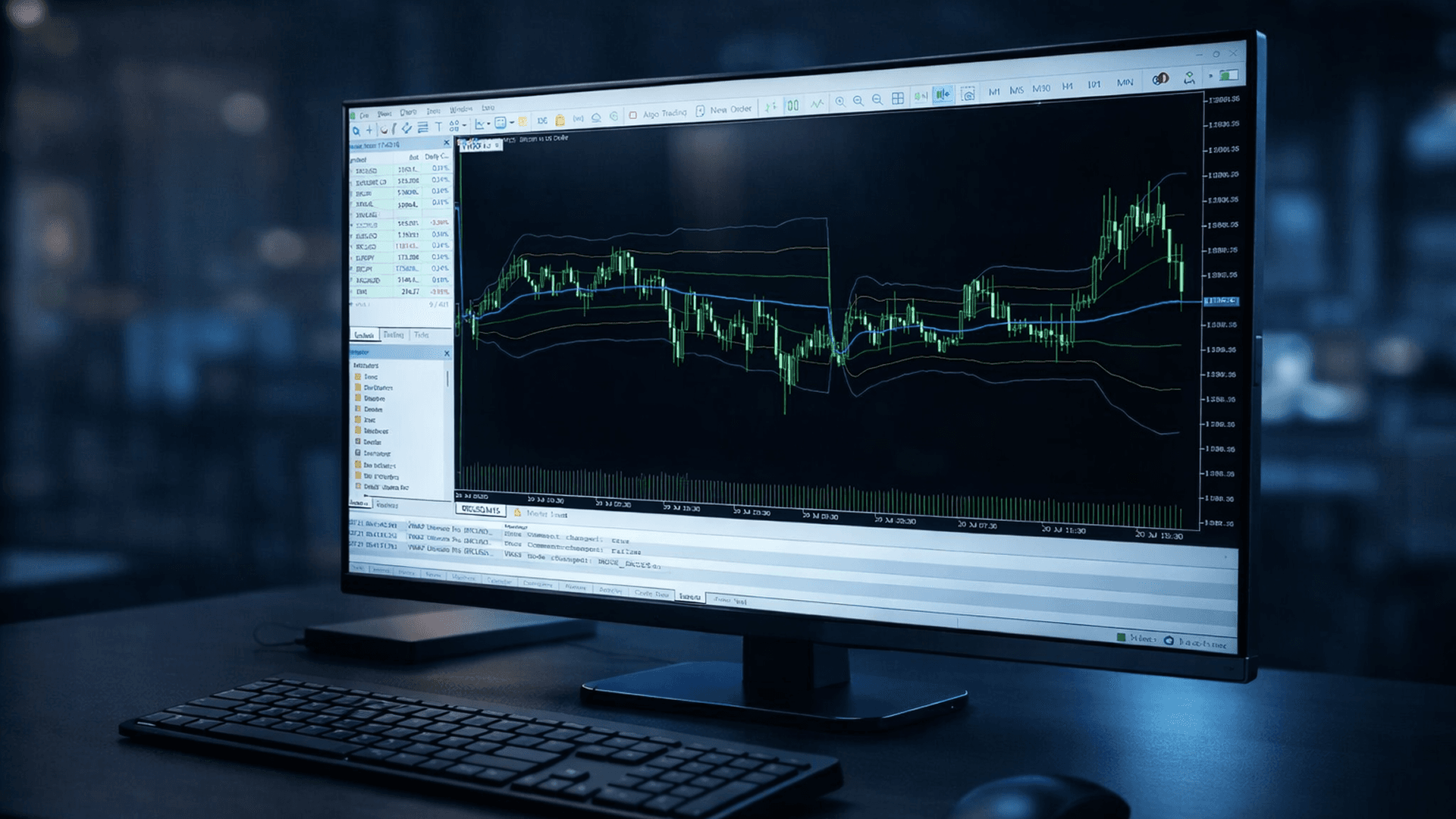
The Volume Weighted Average Price VWAP
Most traders begin their technical analysis journey with moving averages. This is among the most simple-to-apply and easy-to-understand indicators to identify market trends and make predictions. However, one of the shortcomings of moving averages is that they do not consider trading volume. This is where the Volume Weighted Average Price (VWAP) indicator comes to the rescue as an alternative to price-only technical indicators. It is plotted as a single line on an intraday chart that resets at the start of each trading session. It looks similar to a moving average line, measures the average price of an asset for an entire trading day while considering trade volume.
When to use VWAP
VWAP shows the average change in price over a single trading day (by default), weighted by volume. It appears as a trend line below the price chart. It is most commonly used in intra-day trading. Since it combines volume and price analysis, it is often considered a true average price indicator. This technical indicator is most popularly used for short-term trading strategies, such as those with timeframes of M1, M5, M15 and M30.
Institutional traders use VWAP as a benchmark to determine the quality of trade execution. This helps them blend large trades into the market without causing major price swings. Its position as a benchmark encourages traders to include VWAP in their trading strategies.
There are several advantages to using the VWAP indicator:
- Since it includes volume, VWAP is a more accurate indicator of average price than moving averages.
- VWAP is updated throughout the day, which makes it more reliable for real-time insights into market movements.
- Customisations of starting point and candle-period make it adaptable to diverse trading strategies involving various timeframes.
Calculating VWAP
VWAP is a ratio of cumulative typical price change to cumulative daily volume change. Here’s the formula:
VWAP = Σ (Volume × Typical Price) ÷ Σ (Volume)
Where:
Typical Price = (High + Low + Close) ÷ 3 Volume = Number of units traded in each period
By default, the calculation starts at the beginning of the trading day, and the period is selected by the trader. You can choose any timeframe, such as 5 minutes, 30 minutes, or 1 hour. All calculations are done automatically by the charting platform. All you need to do is place the indicator on your chosen asset’s chart and specify the timeframe. The indicator automatically resets each day. However, this makes it difficult to use VWAP for longer-term trading strategies.
Anchored VWAP (AVWAP)
VWAP is a configurable indicator, in which you can set the starting point on the chart. For instance, when a major news break occurs that impacts the asset you are trading. Traders typically change the starting point to the time when the news begins to impact the asset. This way, the VWAP is anchored to a specific time during a trading day and is called AWVAP.
Including VWAP in Your Trading Strategy
The technical indicator starts measuring after the first period is completed. For instance, the typical price for the first five minutes of the day will use the five-minute candle from the start of the trading day. It calculates price change per unit volume for every candle and then plots the trendline.
VWAP can be used for several purposes, such as:
- Identify support and resistance levels: This happens when the price bounces off the VWAP line.
- Trend verification: When the price of an asset is continuously above the VWAP line, it is said to be in an uptrend. An asset is trending downward if the price is constantly below the VWAP line.
- Mean reversion signals: Since prices tend to revert to their average over time, traders use the VWAP technical indicator to discover potential mean reversions and explore the opportunities therein.
Note that the VWAP is a lagging indicator and can start plotting the trend line only after a certain time has passed. It has limited predictive value. Remembering this may help you choose leading indicators to adequately build a trading strategy.
VWAP Trading Strategy
Traders use VWAP to time their entry:
- When the price breaks out above VWAP, it signals a potential uptrend. At such times, traders buy the asset, i.e., take long positions.
- When the price breaks below the VWAP line, they take short-selling positions, expecting a potential downtrend to set in.
VWAP also acts as a dynamic support and resistance level:
- When the price bounces off the VWAP line from below, it is considered a signal to take long positions.
- Traders take short positions when the price bounces from the VWAP line from above.
Combining VWAP with Other Indicators
VWAP can be combined with other technical indicators to strengthen trading strategies.
Using VWAP with Bollinger Bands
Bollinger Bands use a standard deviation from the moving average. Deviations from VWAP help traders identify potential breakouts or reversals. This helps them choose entry points.
Combining VWAP with EMA
Exponential moving average crossovers with the VWAP line signal trend reversal or continuations to help traders determine whether to hold a position or exit.
Confirming Trade Setups with RSI
Traders refer to the relative strength index’s oversold or overbought conditions to confirm their VWAP trade setups.
Developing Trading Algorithms with VWAP
A popular use of the VWAP indicator is to create a standard deviation of the price range anchored to the VWAP. This is similar to Bollinger Bands anchored to the SMA, expect that this one considers volume. This helps create support and resistance regions around the VWAP, which can be used to make informed trading decisions.
Summary
- VWAP considers price and volume changes to calculate average price fluctuations.
- It is most popularly used for short-term trading strategies.
- VWAP can be customised to align with your trading strategy.
- VWAP is used as an indicator of dynamic support and resistance levels and potential reversals.
- When combined with other indicators, VWAP acts as a confirmation signal.
Frequently Asked Questions
1. What is VWAP and how does it work? VWAP calculates the average price of an asset throughout the trading day, weighted by volume, giving a more accurate view than price-only indicators.
2. Why do traders use VWAP instead of moving averages? Unlike moving averages, VWAP includes volume, making it more reliable for assessing true market value and trade quality.
3. Can VWAP be used for long-term trading? VWAP is primarily designed for intraday trading since it resets at the start of each trading session, limiting its use for longer-term strategies.
4. How is VWAP used in trading strategies? Traders use VWAP to identify trends, confirm breakouts, spot support and resistance levels, and time entries and exits—often in combination with other indicators.
Disclaimer:
All information is provided for general informational purposes only and does not constitute investment advice or a recommendation. It does not consider your individual financial situation or objectives. You should seek independent financial advice before making any investment decisions.
While efforts are made to ensure accuracy, no guarantee is given regarding completeness or reliability, and information may change without notice. Past performance is not indicative of future results. Blackwell Global accepts no liability for any losses arising from reliance on this information.