


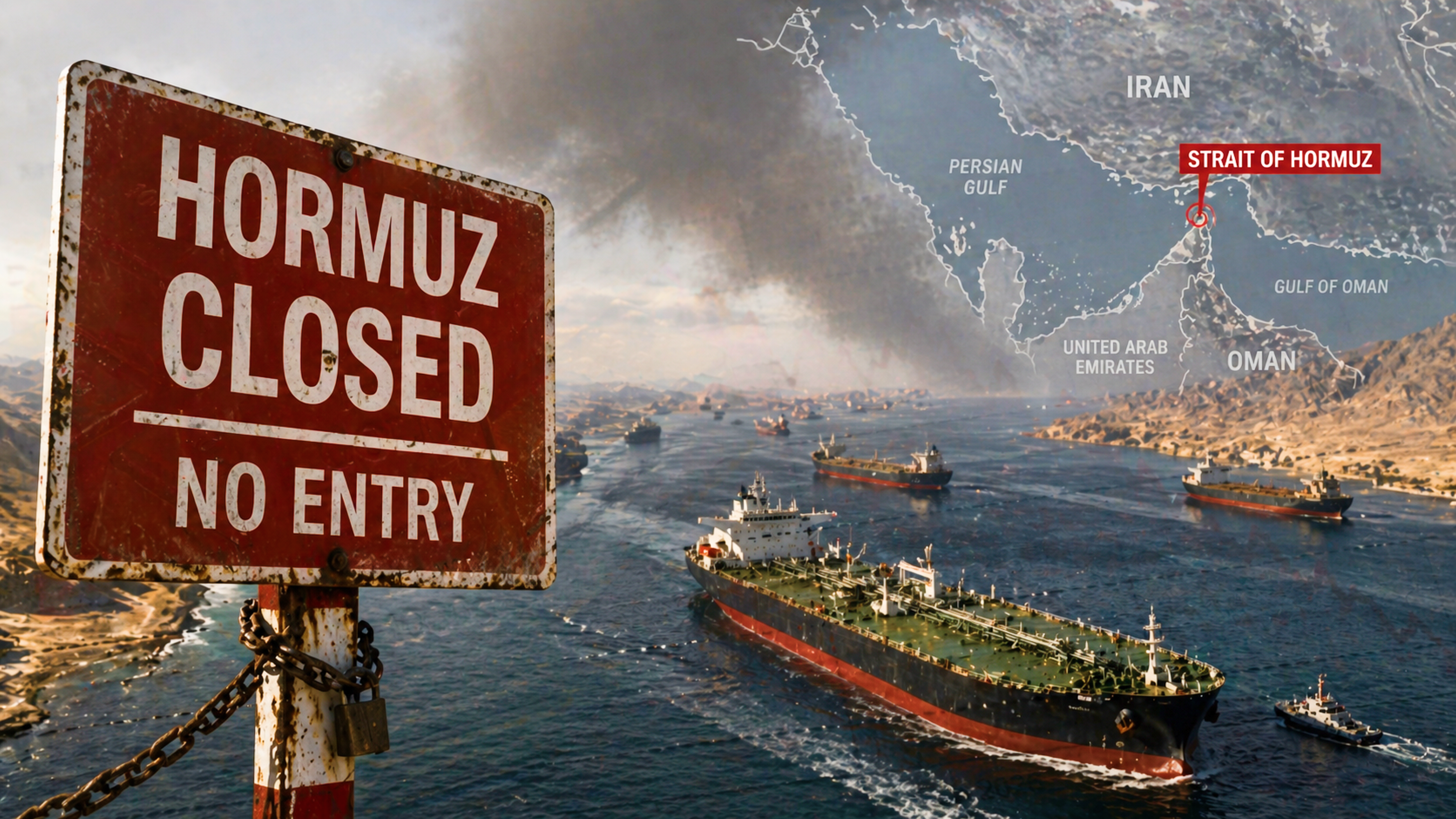
The Significance of the Strait of Hormuz
Serving as a passage for about 20% of the world’s oil and gas shipments, the Strait of Hormuz is one of the world’s most critical energy supply routes. Maritime operators in the region entered a “reactionary-pause” when military escalations caught commercial vessels off-guard after the US-Israel war on Iran began. On March 2, 2026, Iran’s Revolutionary Guard Corps (IRGC) officially closed the Strait of Hormuz, sending a message to all ships via the international distress frequency. As a result, oil tanker traffic through the strait declined by 90%.
A Single Point of Failure
The 21-mile-wide strait is the only maritime exit for many of the world’s largest oil and gas producers, including Saudi Arabia, the UAE, Kuwait, Iraq and Iran. Its closure led to a ripple effect of the regional war on the global economy.
Since the top oil producers cannot ship out, they have to cut their production as their storage facilities reach capacity. Prolonged closure could mean extended production cuts, and oil production may take a while to reach full capacity even after the waterway opens. This could create a longer-term supply crisis.
Historically, supply constraints push energy prices up. By March 19, 2026, WTI crude price had reached $97.6 per barrel, while Brent crude had surged to $114.20, nearly 68% up from a month ago.
Qatar, the world’s second-largest liquid natural gas (LNG) exporter, has no alternative export terminal outside the Gulf. The halt in Qatari shipments means a reduction of 11 billion cubic feet of gas from the market every day. This led to gas prices rising nearly 74% between February 27 and March 9, 2026.
About 80% of the strait’s oil traffic goes to Asia. This means China, India, Japan and South Korea, the primary buyers of Gulf exports, face an energy threat. South Korea is expected to be impacted the most as this single waterway fulfils 80% of its total energy needs. Europe is also in a vulnerable position, since the continent has been relying on Qatari LNG after losing Russian supplies due to sanctions.
The US is vulnerable only to some extent. Although America is a net exporter, domestic gasoline prices have risen by over 25%, thanks to the global nature of oil pricing and fear sentiment in the market.
Historically, when oil prices go up, food prices follow. One-third of the seaborne fertiliser trade passes through Hormuz, which means the cost of food and living may also rise in buying nations. The emerging markets face a multi-level risk to food security, especially in low-income nations.
Trading Oil During Wartime
Volatility in oil markets gives rise to trading opportunities, and also to higher risk. Savvy traders know which strategies to choose and which risk management tactics to ensure are in place while they trade.
Strategies to consider while trading oil during wartime include:
Swing Trading
Historically, oil prices spike immediately on news of the outbreak of war but retreat as disruption fears fade, allowing traders to sell into the initial surge. So, the news of a war breakout is considered a signal to buy, while updates on continued shipping traffic and peace discussions signal a sell.
Range Trading
With increased volatility, bulls and bears try to restrict the price within a range. Organisations like OPEC and institutional investors may attempt to stabilise oil prices. This creates an opportunity to trade within an established technical range. At such times, traders look to buy at support and sell at resistance. The key is to keep an eye on news events and broader sentiment to understand if the price is ready to reverse or if there is enough momentum for a breakout.
Trend Continuation
Using momentum indicators, such as stochastic oscillator, moving average convergence divergence (MACD), and average directional index (ADX) can help. These signal if an uptrend induced by fear has the potential to continue. Combining these with real-time charts to identify pullbacks and use them to enter can help traders ride the uptrend.
Risk Management While Trading Oil
High uncertainty calls for stringent risk management measures.
Learn to Filter Noise
Wartime is also a time for rumours and “secret tips” to surface. Relying only on trusted news sources and sentiment analysis tools is crucial to filter noise.
Limit Position Sizes
Experienced traders follow the rule of limiting exposure per trade to 1% to 2% of their account balance.
Use Limit Orders
Using limit orders, such as stop loss and take profit, along with indicators, like volatility-adjusted average true range (ATR), can help determine adequate limit levels. Experienced traders tend to use trailing stop loss when riding trends.
Diversify
Exploring non-correlated assets and safe havens can help spread risk. For instance, gold and USD strengthen during geopolitical uncertainties. Plus, prices of commodities, such as natural gas and agricultural produce, also surge due to supply chain disruptions, creating trading opportunities.
Summary
The shutdown of the Strait of Hormuz, responsible for around 20% of global oil and gas shipments, triggered a major supply shock across energy markets. Oil and gas prices surged sharply as exports from key producers were disrupted, forcing production cuts and tightening global supply. Asia and Europe remain the most exposed to the crisis, while ripple effects extend to food prices and inflation due to disrupted fertiliser trade.
For traders, this environment creates both opportunity and risk. Strategies such as swing trading, range trading, and trend continuation become relevant during periods of heightened volatility. However, success depends heavily on disciplined risk management, including position sizing, filtering market noise, and diversification into safe-haven assets like gold and the US dollar.
Frequently Asked Questions
1. Why is the Strait of Hormuz important to global markets? It handles about 20% of global oil and gas shipments, making it a critical chokepoint for energy supply worldwide.
2. What happens to oil prices when supply routes are disrupted? Supply shocks typically drive oil and gas prices higher due to reduced availability and increased market uncertainty.
3. Which regions are most affected by the Hormuz closure? Asia and Europe are the most impacted, as they rely heavily on Gulf energy exports passing through the strait.
4. How can traders approach oil markets during geopolitical crises? Traders often use strategies like swing trading, range trading, and momentum-based trend trading while closely monitoring news and sentiment.
5. What risk management strategies are important in volatile markets? Key practices include limiting position size, using stop-loss orders, diversifying assets, and relying on verified information sources.
Disclaimer:
All information is provided for general informational purposes only and does not constitute investment advice or a recommendation. It does not consider your individual financial situation or objectives. You should seek independent financial advice before making any investment decisions.
While efforts are made to ensure accuracy, no guarantee is given regarding completeness or reliability, and information may change without notice. Past performance is not indicative of future results. Blackwell Global accepts no liability for any losses arising from reliance on this information.