


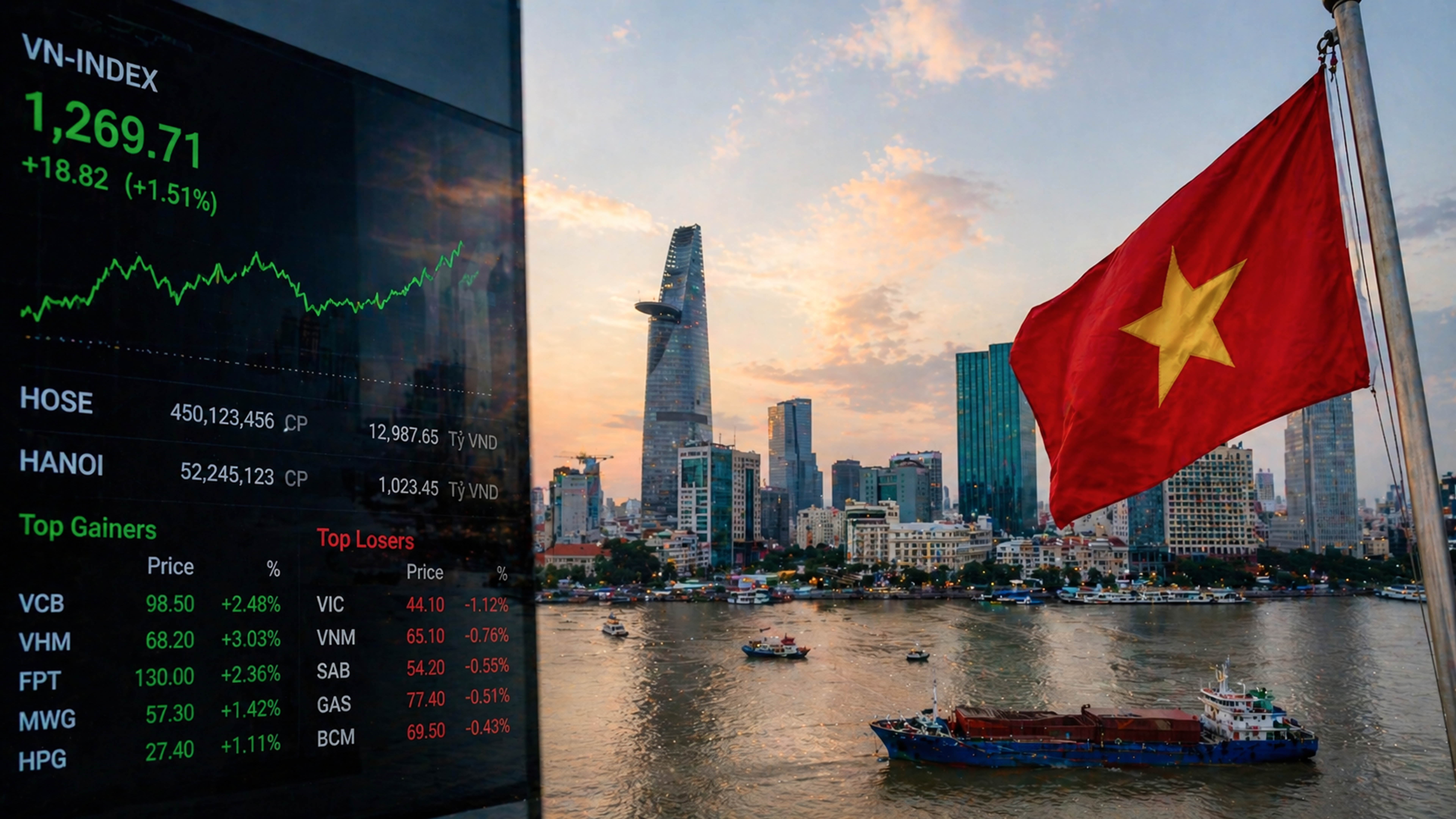
Traders Eyeing Veitnamese Equities
According to FTSE Russel, Vietnam is due for a promotion to a secondary emerging market status from its long-standing frontier market status. The key drivers for this include the stabilising regulatory framework and maturing market conditions. Retail investors account for over 88% of the total market participation in the country. While a market with a high risk-reward ratio can be attractive, it demands a resilient trading strategy and robust risk management. If you too wish to capture opportunities in the Vietnamese market, the first step is to understand why it is appealing for investors and then decide how much to risk per trade.
Vietnam’s Rising Appeal for Global Investors
Despite a global glut in M&A activity through 2025, Vietnam closed over 220 transactions with a total deal value of $2.3 billion. Real estate, healthcare and supply chain relocation are among the top sectors attracting capital inflows to the country. Vietnam attracted $38.42 billion in registered Foreign Direct Investment (FDI) in 2025, a 0.5% year-on-year increase, according to the National Statistics Office (NSO).
Manufacturing is also among the popular sectors for foreign investment. This is because the government continues to invest in supply chains, advanced technologies and environmentally sustainable industries. It aims to strengthen the country’s industrial base and attract international companies, positioning Vietnam as a production hub in Southeast Asia.
Plus, the country’s increasing participation in global trade networks plays a key role in attracting FDI. Vietnam has signed numerous free trade agreements with major economic partners, strengthening its access to international markets and supply chains. Strategic partnerships with economies like Japan, South Korea and the United States have supported investment flows and cross-border business activity.
About 67.6% of the population in Vietnam falls within the working age group of 15 to 64. This is also the part of the population that tends to invest disposable income for future expenses and retirement. Household disposable income has also grown in the country. Since gold and real estate require a bigger corpus, equities become the preferred investment channel.
Outlook 2026
Vietnam is set to gain its secondary emerging market status by September 2026. The country’s economic growth, expanding consumer base and increasing integration into global trade networks have positioned it as one of Asia’s most dynamic emerging markets.
While the global growth rate is forecasted to remain around 2.4% through 2026, Vietnam’s GDP is estimated to grow at a whopping 7.5%.
Additionally, 2026 marks the beginning of the final stage of the country’s 10-year socio-economic development strategy (2021-2030). It is expected to create momentum for the final sprint towards Vietnam’s growth goals for the decade.
What This Means for Traders
The emerging markets often offer higher growth potential compared with more mature markets, particularly when supported by strong economic fundamentals. Given the slump in broader global growth, traders are increasingly exploring growth opportunities in the emerging markets, including Vietnam. These usually present a mix of opportunity and volatility. Trading in such environments requires disciplined decision-making and clear risk management principles, such as quantifying how much to risk per trade. It might also be useful to learn how professional traders manage risk in such markets.
Exploring the Vietnamese Market
To get wider exposure, traders explore benchmark indices, such as the VN-Index and VN30. These represent the largest listed companies on the Ho Chi Minh Stock Exchange. They also serve as the barometer for overall market sentiment.
Compared to the developed markets, Vietnamese equities can exhibit higher intraday volatility and thinner institutional liquidity. This means price movements can accelerate quickly due to strong buying or selling pressure. Techniques, such as scalping and high-frequency trading, are often used by traders to access opportunities during rapid price swings.
Combine macro factors with technical indicators, such as moving averages, momentum indicators and breakout levels, to determine entry and exit points. Indicators, such as RSI and Bollinger bands, can help identify potential trend continuation or exhaustion points.
Exploring contracts for differences (CFDs) as a trading instrument can widens potential exposure. This is because these derivative instruments allow traders to participate in rising as well as falling markets.
What to Watch
- Momentum around the FTSE Russell emerging market upgrade date.
- Foreign capital inflows.
- Manufacturing export data and supply-chain relocation.
- Geopolitical tensions affecting supply chains and tariffs affecting global trade.
How Professional Traders Manage Risk in Emerging Markets
Professional traders typically define clear risk limits that help determine how much they are willing to risk per trade.
Limiting the percentage of capital exposed to any single trade is one of the most prominently used risk management techniques. Many traders use guidelines such as risking only 1% to 2% of their trading capital on one position.
This means on a $10,000 trading account with a 1% risk rule, the maximum risk per trade would be $100. Here, position sizes and stop-loss levels are calculated so that potential losses do not exceed this threshold. This approach tries to lower the impact on the overall capital even after a series of unfavourable trades.
Determining how much to risk per trade depends on factors such as account size, risk tolerance and market volatility. In the emerging markets, traders may adjust their position size to account for potential price swings.
Professional traders also diversify their exposure across multiple assets or sectors to spread the risk across different investments instead of concentrating it on a single opportunity.
Limit orders are another technique to set exit levels using stop-loss and take profit. This helps maintain discipline and remove emotional decision-making from the trading process.
Summary
Vietnam is rapidly positioning itself as one of Asia’s most attractive emerging markets, driven by strong GDP growth, rising foreign investment, and deepening integration into global trade networks. With a projected economic growth rate of 7.5% in 2026 and a potential upgrade to secondary emerging market status, investor interest continues to rise.
The market is supported by robust fundamentals, including a young working population, increasing disposable income, and strong inflows into sectors like manufacturing, real estate, and healthcare. However, high retail participation and relatively lower institutional liquidity contribute to increased volatility.
For traders, this creates both opportunity and risk. Exposure can be gained through indices like VN-Index and VN30, while strategies such as scalping, momentum trading, and breakout analysis are commonly used. Success in this environment depends on disciplined risk management, including position sizing, diversification, and strict use of stop-loss levels.
Frequently Asked Questions
1. Why are investors interested in Vietnamese equities? Strong economic growth, rising foreign investment, and Vietnam’s potential upgrade to emerging market status are attracting global attention.
2. What makes Vietnam a high-growth market? Factors include a young population, increasing disposable income, expanding manufacturing sector, and strong participation in global trade.
3. What risks are associated with trading Vietnamese stocks? Higher volatility, lower institutional liquidity, and sensitivity to global trade dynamics can lead to rapid price swings.
4. How can traders gain exposure to the Vietnamese market? Through benchmark indices like the VN-Index and VN30 or via derivatives such as CFDs.
5. What risk management strategies are important in emerging markets? Limiting risk per trade (typically 1–2%), diversifying investments, and using stop-loss and take-profit orders are key practices.
Disclaimer:
All information is provided for general informational purposes only and does not constitute investment advice or a recommendation. It does not consider your individual financial situation or objectives. You should seek independent financial advice before making any investment decisions.
While efforts are made to ensure accuracy, no guarantee is given regarding completeness or reliability, and information may change without notice. Past performance is not indicative of future results. Blackwell Global accepts no liability for any losses arising from reliance on this information.