


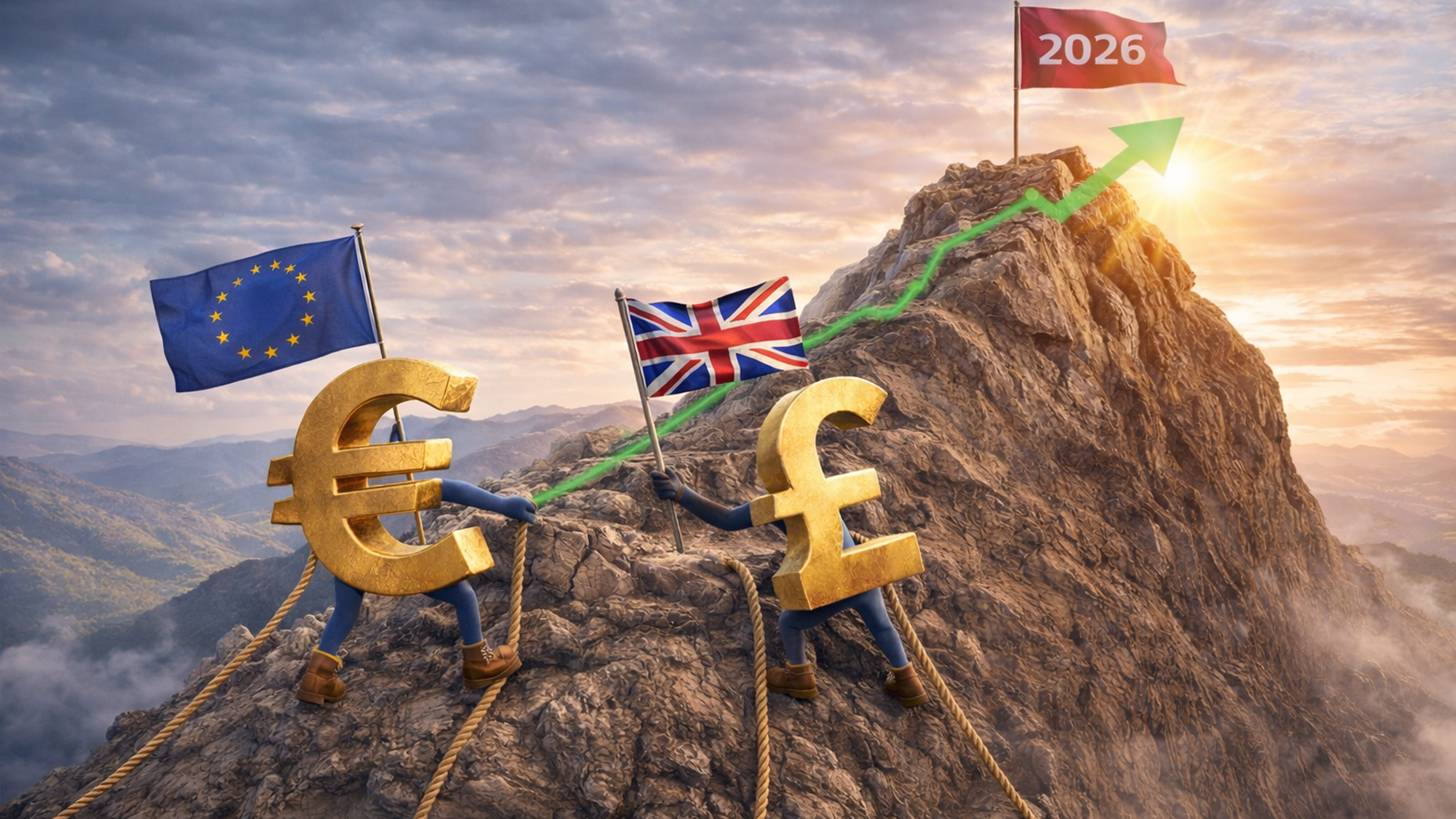
EUR/GBP on the Rise: A Key Minor Pair Gaining Momentum
The EUR/GBP surged from 0.82 (January) to 0.88 (November) in 2025. Up nearly 6%, the ‘Chunnel’ is one of the most traded minor pairs by volume. Strong ties between the UK and Eurozone, due to geographic and economic interdependencies, keep the demand for the pair quite high in the continent. The EUR/GBP is a liquid forex pair, especially during London trading hours.
What to Watch in Q1 2026?
The factors that may push Chunnel even higher are:
Monetary Policy Divergence
Year-on-year inflation in the Eurozone stayed within the 2% to 2.2% range from August through November 2025. Although it was higher than the consensus in November at 2.2%, it was still close to the European Central Bank’s (ECB’s) target. This is after the ECB halted its rate cut cycle in July. The likelihood of the bank lowering interest rates in Q1 2026 remains low, especially if inflation stays range bound.
In contrast, sluggish economic growth may encourage the Bank of England (BOE) to support economic recovery. The BOE is expected to lower interest rates by at least 50 bps through 2026. If inflation declines significantly faster than expected, the rate cuts could get aggressive. This may further support the EUR/GBP.
Economic Outlook
S&P Global forecasts that economic growth in the Eurozone will remain stable at 1.2% in 2026. Germany’s expansive policy may have spill over effects impacting Central and Eastern Europe. Digital transformation with a push to develop competitive AI infrastructure could also be a key growth driver in the bloc. The growth outlook for the UK appears to be weak, with KPMG research suggesting a surge in unemployment and a potential jobless rate of 5.2% in 2026. Weakness in job creation hurts investor confidence in the currency, which may weigh on GBP.
Note that economic recovery in the Eurozone is quite fragile, with persistent disparity across member nations. On the other hand, the UK economy is more resilient and has been showing signs of growth despite a slowdown. These contrasting factors may add to the volatility of the pound sterling.
Analyst Forecasts That Drive Market Sentiment
ING Bank forecasts the EUR/GBP to hit £0.90 if aggressive rate cuts continue in the UK, while Danske Bank expects the forex pair to trade around £0.89 through the first half of 2026. The markets weigh in such forecasts, and traders refine their forex trading strategies accordingly. Keeping an eye on analyst expectations can offer insights into market sentiment and help make informed EUR/GBP trading decisions. A change in these forecasts is also reflected in market behaviour.
Political Developments
Stability of the government and investor trust in policies deeply impact the financial markets. The EU has a riskier political environment, with several signs of political unrest. For instance, anti-government protests in Bulgaria, rising polarisation in Germany and the French parliament ousting the prime minister after rejecting the debt-cutting plan. Such events weigh on the bloc’s currency and are potential tailwinds to the Chunnel. In contrast, the UK has a relatively stable political environment, although voter support remains volatile.
IMF’s Warning of Disorderly Market Correction
The International Monetary Fund (IMF) believes that global financial stability is at risk. The ongoing large public deficits, geopolitical tensions and trade wars increase the chances of a sudden, “disorderly” global market correction. The IMF pointed out that increasingly deepening ties between banks and less regulated financial service firms amplify the risks while government debt worldwide remains elevated. Heightened uncertainty leads traders to reduce exposure to riskier currencies. Such a scenario supports the EUR relative to the GBP.
Technical Indicators for Trading EUR/GBP in 2026
While fundamentals move forex pairs, technical indicators help you identify entry and exit points. Here are popular indicators to refine your forex trading.
Moving Averages (MA)
You can use either simple moving average (SMA) or an exponential moving average (EMA). When a short-term MA crosses above a long-term MA, it is considered a buy signal. When it crosses below, it is time to sell. For instance, a 50-day EMA crossing above a 200-day EMA is called a “golden cross.” This is often considered a time to go long.
Relative Strength Index (RSI)
RSI measures momentum on a scale from 0 to 100. A reading above 70 signals overbought market conditions, while a reading below 30 indicates an oversold market. Traders use RSI to speculate on reversals. An RSI value above 70 may be an early signal of a pullback, this is when you sell. An RSI near 30 may signal a potential bounce, or a time to go long.
Bollinger Bands
Bollinger Bands show price volatility through an upper, middle and lower band. A thin channel may indicate consolidation and potential for the price to break out. Consider going short on a breakout below the lower a band and long on a breakout above the upper band. A bounce from one of the bands indicates a strongly ranging market.
Fibonacci Retracement
Fibonacci levels help find possible price reversal and breakout points. Key levels are 38.2%, 50%, and 61.8%. These can be used as potential price targets or stop loss levels to exit EUR/GBP trades.
Volume Indicators
High volume confirms the strength of price moves and the underlying trend. Indicators like On-Balance Volume (OBV) help traders determine the strength of a trend to identify entry and exit points.
Summary
- The EUR/GBP has potential to reach 0.89 in Q1 2026.
- Keeping an eye on inflation, interest rate decisions and political stability of the two regions can help traders speculate the movements in this forex pair.
- Technical indicators used to determine entry and exit points while trading the EUR/GBP include Bollinger Bands, moving averages, RSI, Fibonacci levels and on-balance volume.
Frequently Asked Questions
1. Why is EUR/GBP gaining momentum? Diverging monetary policies, stable rates in the Eurozone, and expected rate cuts in the UK are supporting the euro against the pound.
2. What factors influence EUR/GBP movements? Key drivers include interest rate decisions, inflation trends, economic growth, and political stability in both regions.
3. How do traders analyze EUR/GBP? Traders combine fundamental analysis with technical indicators like moving averages, RSI, Bollinger Bands, and Fibonacci retracements.
4. What makes EUR/GBP a popular trading pair? Its high liquidity, strong economic ties between the UK and Eurozone, and consistent volatility make it attractive for traders.
Disclaimer:
All information is provided for general informational purposes only and does not constitute investment advice or a recommendation. It does not consider your individual financial situation or objectives. You should seek independent financial advice before making any investment decisions.
While efforts are made to ensure accuracy, no guarantee is given regarding completeness or reliability, and information may change without notice. Past performance is not indicative of future results. Blackwell Global accepts no liability for any losses arising from reliance on this information.